
 Call Us
  WhatsApp 07427 935161
 Mon-Fri: 9.00am - 5.30pm





Since April 2002, all replacement glazing has come within the scope of the Building Regulations. This means anyone who installs replacement upvc windows or external doors has to comply with new thermal performance standards. (Just replacing the glass is exempt).
When the time comes to sell your property, your purchaser's surveyors will ask for evidence that any replacement glazing installed after April 2002 complies with the new Building Regulations. There are two ways to prove compliance:
- A certificate showing that the work has been done by an installer who is registered under the FENSA Scheme
- A certificate from the local authority saying that the installation has approval under the Building Regulations.
The FENSA Scheme
The FENSA scheme allows window and door installation companies that meet certain criteria to self-certify that their work complies with the Building Regulations. It was set up by the Glass and Glazing Federation, in association with all key stakeholders, and meets with central Government approval. A sample of the work of every installer is inspected by FENSA appointed inspectors to ensure standards are maintained and installers who fail to perform can be suspended or even excluded from the scheme. FENSA also inform local authorities of all completed FENSA installations and issue certificates to householders confirming compliance.
Any installation done by a firm which is not registered by FENSA, including work done as a DIY project by a homeowner, needs full local authority approval under the Building Regulations. You should note that you, as the homeowner, are ultimately responsible for ensuring the work complies with the Building Regulations.
FENSA Guide for Compliance - Download
Means of Fire Escape - Part B
Fire escape windows are required in certain rooms in a home.
- On the ground floor, fire escape windows are required in any habitable room that does not open directly into a hallway that leads to an exit door. This includes bedrooms, living rooms and studies.
- On upper floors up to 4.5 meters from ground level, fire escape windows are required in all habitable rooms that do not have direct access to a protected stairway. This includes bedrooms, living rooms and studies.
The window clear opening must be at least 0.33 square meters and at least 450 millimeters high or wide.
- If one of the dimensions is 450 millimeters, the other dimension must be at least 750 millimeters to achieve 0.33 square meters.
- The bottom of the window opening must be no more than 1100 millimeters from the floor.
Our Fire Escape and Easy Clean hinges comply with these regulations providing the clear opening is met.
- These hinges allow the window to open without obstruction, so that it meets the minimum size requirements.
- We recommend at least a 600mm side opening width to achieve the clear 450mm opening width requirement.
Approved Document B - Download
Ventilation - Part F
A trickle vent is a very small opening in a window or other building envelope component to allow small amounts of ventilation in spaces intended to be naturally ventilated when major elements of the design - windows, doors, etc., are otherwise closed. Build regulations state that you are required to replace windows like for like. If the original installation already had background ventilation (e.g., trickle vents), new windows must provide at least the same amount of ventilation, typically via trickle vents at equal or greater equivalent area. All windows to be fitted in new builds and extensions will require trickle vents.
Part F does not say trickle vents are the only method — it requires adequate ventilation levels. Trickle vents are a practical and commonly accepted means of compliance. However, alternative systems (mechanical ventilation) can also meet Part F if designed and tested appropriately.
We strongly recommend that you take the time to read the table below to allow you to develop your own understanding, however, for the purpose of providing context for this communication, see below excerpt which we feel offers a good general overview of the aspects which impact our industry the most:
| Room | Minimum equivalent area of background ventilators for dwellings with multiple floors | Minimum equivalent area of background ventilators for single-storey dwellings |
|---|---|---|
| Habitable rooms | 8000mm² | 10,000mm² |
| Kitchen | 8000mm² | 10,000mm² |
| Utility | no minimum | no minimum |
| Bathroom | 4000mm² | 4000mm² |
| Sanitary accommodation | no minimum | no minimum |
1. The use of the above table is not appropriate in any of the following situations and expert advice should be sought.
- If the dwelling has only one exposed façade.
- If the dwelling has at least 70% of its openings on the same façade.
- If a kitchen has no windows or external façade through which a ventilator can be installed.
2. Where a kitchen and living room accommodation are not separate rooms (i.e. open plan), no fewer than three ventilators of the same equivalent area as for other habitable rooms should be provided within the open-plan space.
3. The total number of ventilators installed in a dwelling’s habitable rooms and kitchens should be no fewer than five, except in one-bedroom properties, where there should be no fewer than four.
4. If a bathroom has no window or external façade through which a ventilator can be installed, the minimum equivalent area specified should be added to the ventilator sizes specified in other rooms.
The new building regulations state trickle vents will be required by law in the majority of situations. There are exemptions to the rule (eg listed buildings and conservation areas) and these should be discussed with your FENSA Approved Installer or local building control officer.
If there are already vents fitted on the original windows, then you can fit the same sized vents on the new windows. For example, 2500mm2 EA vents can be replaced with 2500mm2 EA vents or higher. Just remember that the airflow cannot be decreased.
If the existing windows do not have vents, then the replacement windows must have vents fitted to meet the requirements of the revised Approved Document F. For houses in England, that means a minimum airflow of 8000mm2 EA in habitable rooms and 4000mm2 EA in non-habitable rooms.
Approved Document F - Download
Thermal Efficiency and Performance - Part L
2022 Changes to Document L1A
The targeted specification value can be described as the desired u-value and the limiting value is the minimum requirement.
Also, note that a new home is always built to a minimum standard of total energy performance.
- Targeted specification value for windows and glazed doors with >60% glazed area: 1.2 U-value
- Targeted specification value for semi-glazed door (30-60% glazed area): 1.0 U-value
- Limiting standard for any windows and doors: 1.6 U-value
As per the limiting standard listed, windows and doors installed into a new dwelling are required to be of 1.6 U-value or less. If the U-value of the windows and glazed doors is between 1.3 – 1.5 (higher than the targeted specification value of 1.2), another element such as the external walls will need to achieve a better u-value than the target stated for that element for the dwelling to achieve its minimum standard of total energy performance.
2022 Changes to Document L1B
All replacement windows and doors must be no worse than what is being replaced or:
- Replacement windows to be at least 1.4 U-value or Window Energy Rating B
- Replacement doors with >60% glazing to be at least 1.4 U-value or Doorset Energy Rating C
- All other replacement doors to be at least 1.4 U-value or Doorset Energy Rating B
| NEW DOCUMENT L1B STANDARDS 2022 | DOCUMENT L1B STANDARDS 2016 | |
|---|---|---|
| Replacement windows | U Value = 1.4W/m²K or Window Energy Rating Band B | U-Value = 1.6W/m²K or Window Energy Rating = Band C |
| Replacement doors with more than 60% area glazed | U Value = 1.4W/m²K or Doorset Energy Rating Band C | 1.8W/m²K (or exempt if fitted into existing door frame) |
| Other replacement doors | U Value = 1.4W/m²K or Doorset Energy Rating Band B | 1.8W/m²K (or exempt if fitted into existing door frame) |
U values are calculated for the whole unit, both glazing and frame.
Our standard A rated windows achieve a U value of 1.3 and our most energy efficient triple glazed windows achieve a U value of just 0.9 and WER Band A++.
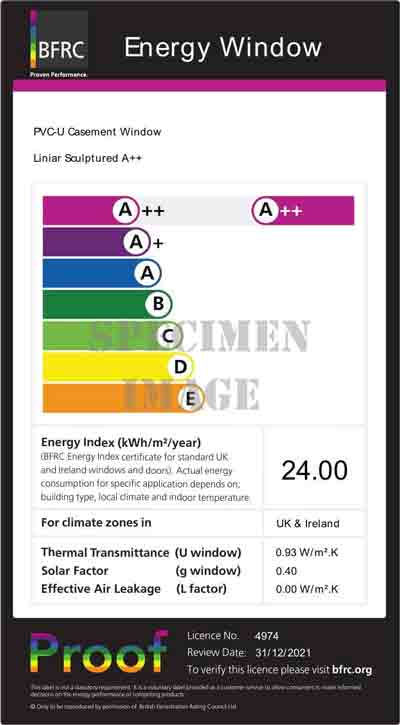
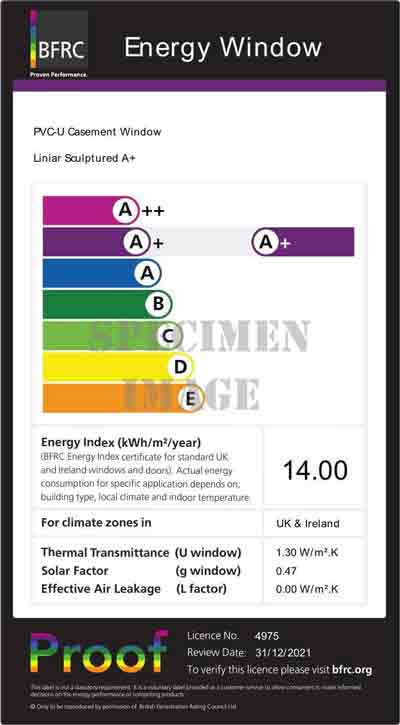
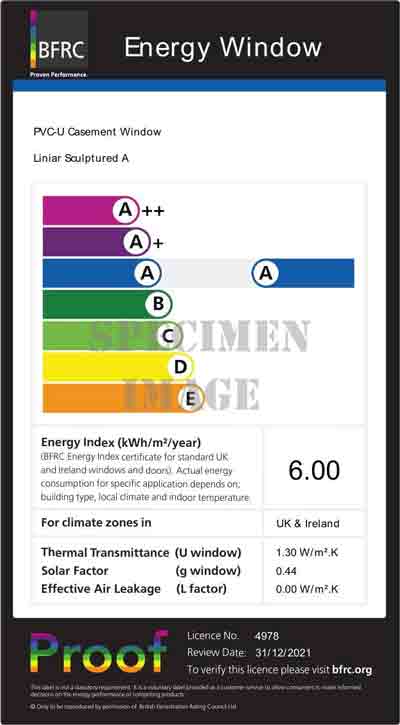
Approved Document Part L - Download
Wheelchair Access - Part M
All new builds are required to meet building regulations Part M. This is to achieve a minimum clear opening width of 775mm.
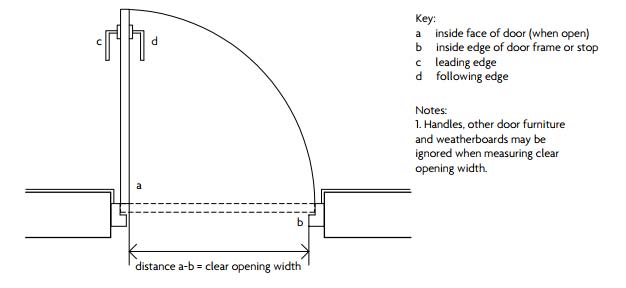
Approved Document Part M - Download
Toughened Safety Glass - Part N
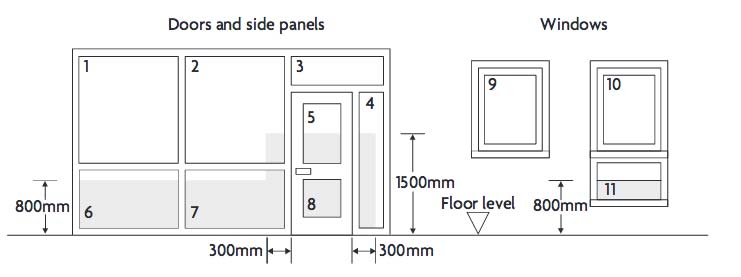
The glass units in windows will have to be toughened if the lowest part of the window is 800mm from the floor. All glass units for doors must be toughened as windows that are connected to doors (side panels and flag windows).
The shaded areas shown in the diagram below show critical locations where toughened safety glass will be required.
Security - Part Q
Designed to ensure the prevention of unauthorised access to dwellings (including flats).
Approved Document Part Q - Download
Why Choose House of Windows?
Energy Efficient
Our doors and windows are super energy efficient, helping you save significantly on your energy bills every month.
Quality Assured
We stand by our service and quality with a comprehensive guarantee.
Nationwide Delivery
Get your order delivered fast and free throughout the UK.
Low Price Promise
We'll match any like-for-like quote from online competitors, ensuring you the best value.
Friendly & Helpful Service
Our friendly customer support team is here to assist you every step of the way. Call 01530 515161.
Request a Quotation
Submit your requirements and we'll gladly provide a quick and competitive quotation. +Click Here